Summer 7 min read · Updated July 2026
When and how to trim a hedge (without harming wildlife)
The best time to cut each type of hedge, how to get a straight line, the nesting bird rules and how to rescue an overgrown hedge.
A well-cut hedge is dense to the ground, straight on top and slightly narrower at the top than at the base. It's a better fence than a fence: it shelters wildlife, filters noise and looks better every year. Here's how to keep it that way.
Nesting birds and the law
All wild birds, their nests and eggs are protected by law while the nest is being built or used. Damaging an active nest is an offence, even by accident. Nesting season runs roughly from March to August.
- Avoid heavy cutting during these months where you can.
- If you must trim, check carefully first. Watch for birds flying in and out, and look inside the hedge.
- If you find an active nest, leave that section until the young have left.
When to cut each type of hedge
| Hedge | When to trim | How often |
|---|---|---|
| Beech, hornbeam | Late summer | Once a year |
| Privet, lonicera | May to August | 2–3 times a year |
| Leylandii, other conifers | April to August | 2–3 times a year |
| Yew | Late summer to early autumn | Once or twice a year |
| Laurel | Late spring to late summer | Once or twice a year |
| Box | Early summer and late summer | Twice a year |
| Hawthorn, mixed native | Winter, after berries are eaten | Once a year, or every other year |
The right shape
Cut hedges so they're slightly wider at the base than the top. This slope is called a batter. It lets light reach the lower branches, so the hedge stays leafy right to the ground instead of going bare and gappy at the bottom.
For a formal hedge, aim for a taper of about 5–10cm for every metre of height. A flat or slightly rounded top sheds snow better than a wide flat one.
How to get a straight line
- Set up a guide. Push canes in at each end and run a taut string along the height you want.
- Cut the sides first, working from the bottom up, in smooth sweeping arcs.
- Keep the blade parallel to the hedge face. Step back every few metres to check the line.
- Cut the top last, along the string.
- Lay a sheet at the base before you start. Clearing up takes half the time.
Large-leaved hedges
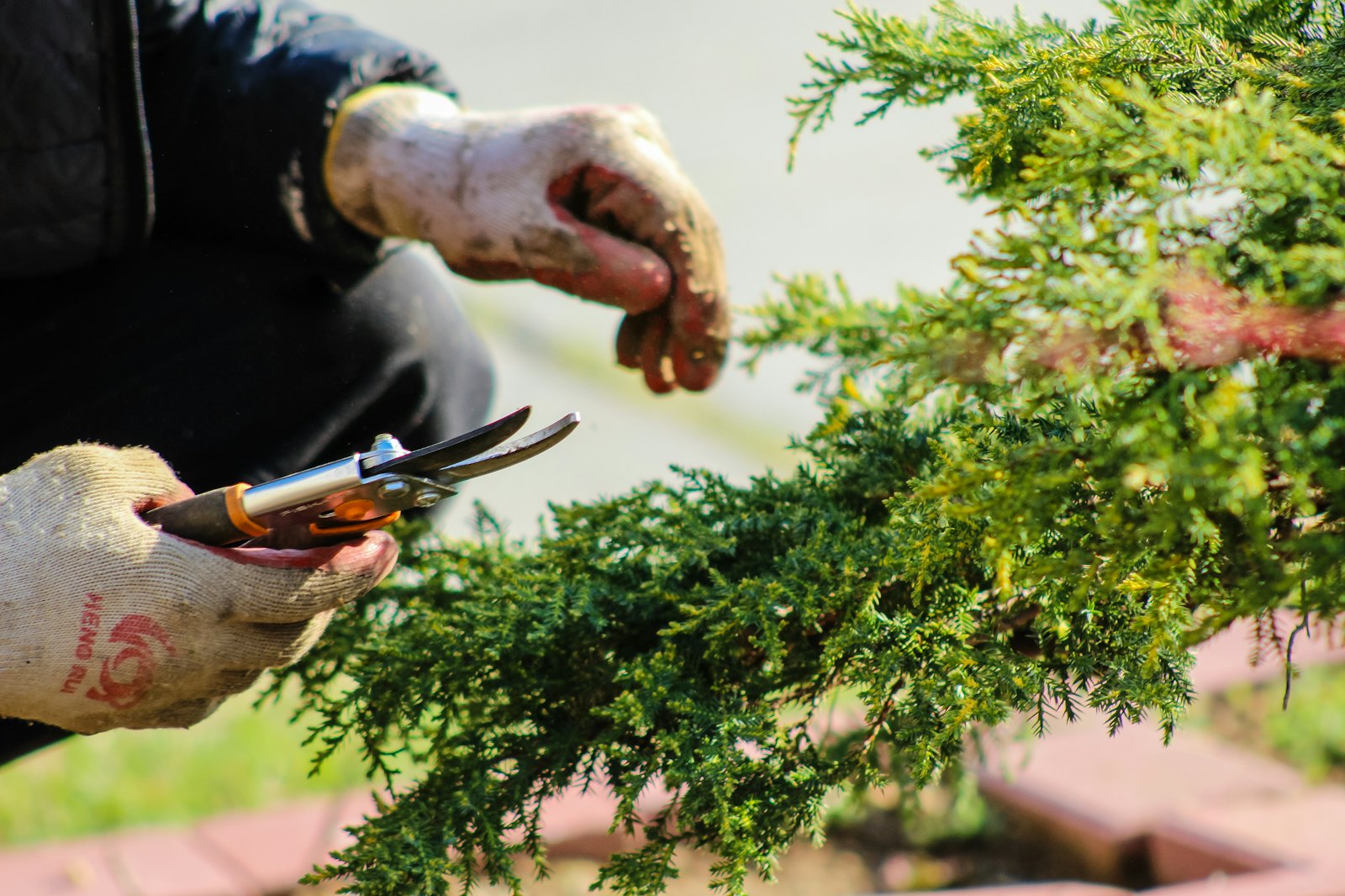
Hedge trimmers slice laurel leaves in half, leaving brown edges that look scruffy for weeks. On laurel and other large-leaved hedges, use secateurs to cut individual stems just above a leaf where you can. It's slower, but it looks far better.
Conifers and leylandii
Most conifers won't regrow from old brown wood. If you cut back past the green growth, you'll be left with a permanent bare patch. Trim little and often to keep conifers under control. Never let a leylandii hedge get away from you: once it's too big, the only real fix is replacing it.
Rescuing an overgrown hedge
Most deciduous hedges (beech, hornbeam, privet, hawthorn) and yew can be cut back hard. Spread the work over two or three years so the hedge isn't shocked:
- Year one: cut one side back hard, close to the main stems. Trim the other side normally.
- Year two: once the first side has regrown, cut back the other side.
- Year three: reduce the height if needed.
Do hard renovation of deciduous hedges in winter when they're dormant (and birds aren't nesting). Do evergreens in mid-spring. Feed and mulch afterwards to help them recover.
Rather we did it for you?
Fernhill Garden Care looks after gardens across Ashford, Wye, Charing, Hamstreet, Kennington, Willesborough, Great Chart and Tenterden. Book a free visit and we'll quote for exactly what your garden needs.
Book a free visit